Foresight Key in Hyman Goldstein’s Legacy
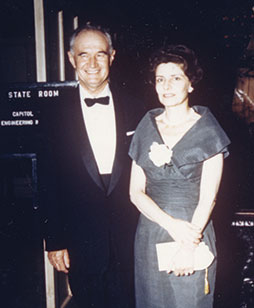 |
Known among friends and colleagues as “Abe Lincoln,” whom he resembled in character and appearance, the late Hyman Goldstein, LLB ’20, created a legacy marked by a sterling reputation of integrity and foresight. “Clients, friends, and family all looked to him for advice not only in matters of business, but in life. They trusted his judgment,” his nephew Morton Goldstein, JD ’61 says.
After working for Western Union for several years, Hy (as he was called by all) started his own law practice on 14th and F St. in Northwest D.C., just across the street from the Western Union office where he first began his career. Hy practiced estate and business, personal and estate law from the mid-1920s until his death in 1965.
Part of Hy’s look to the future included the establishment of two trusts, one providing support for his wife Jeanne, and one providing support for his mother, wife, and other family members, ultimately bequeathing the majority of the remainder of the trusts’ assets to various charities and academic institutions, including a substantial gift to GW Law School.
Jeanne Goldstein, who passed on March 23, 2008, came to America after being rescued from a boat that was torpedoed on its way to the United States from Argentina during World War II. Arriving in the U.S. with only the clothes on her back, she learned firsthand the impact of charitable organizations. It is largely because of her experiences that she became a philanthropist herself, leaving the bulk of her personal estate to various charities and academic institutions including GW Law School, her husband’s alma mater.
Hy and Jeanne Goldstein’s nephew Morton Goldstein, also a graduate of GW Law School from the Class of 1961, is a trustee for Hy’s trusts and a personal representative of Jeanne’s estate. With the encouragement of his uncle, Morton attended GW Law School clerking for his uncle’s law firm; and upon passing the bar, spent five years with the Office of the Corporation Counsel (now the Attorney General of D.C.). “I wanted to practice law with my uncle as soon as I passed the bar, but he felt strongly that young attorneys should first work in a larger arena before entering private practice.”
“My uncle recognized that there were many things not being taught in the classroom that a good lawyer needs. He wanted to change that, desiring to see law schools teach the application of legal knowledge in dealing with clients and particularly with their colleagues as adversaries.” Morton recalls Hy’s keen insight in predicting shifts in the law profession long before they took effect. He recognized that the increased cost of education and a greater focus on winning in the courtroom would lead to more litigation—a trend that would create crowded court dockets and frustrated, unhappy clients. In response, Hy advocated a system where reasonable solutions could be accomplished through collaborative and amicable work with clients and attorneys outside the courtroom. He hoped that his bequest could help develop these skills in young GW Law students.
“He had great vision,” adds Morton. “He saw things hap-pening in the law profession long before the rest of us did.”
© Pentera, Inc. Planned giving content. All rights reserved.
Disclaimer