Engineering the Future of Public Interest Law
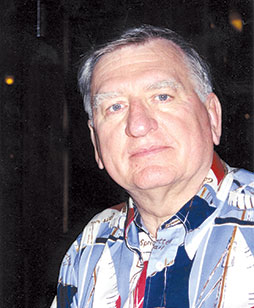 |
For a man who spent a remarkable career developing submarine, missile, and nuclear weapons technology, it is not unusual that John Kucharski casts and paints miniature pewter Napoleonic War-era soldiers. The former chairman and CEO of publicly traded Edgerton, Germeshausen, and Grier, Inc., prior to its 1999 merger with Perkinelmer Inc., ran his first company while at GW Law School in 1965.
Kucharski, 71, earned a bachelor of science degree in electrical engineering from Marquette University in 1958. After graduation, he worked for AC Electronics, a subsidiary of General Motors Corp., producing missile guidance systems and gun sites for the U.S. Air Force. Motivated to pursue law instead of engineering, Kucharski and his family set out for Washington, D.C.
While serving full-time as the director of engineering for Howard Research Corp. in Bethesda, Md., he attended law school in the evening. Although he began with the intent of becoming a patent attorney, he quickly changed his mind. “I just wasn’t that interested in patent law after taking my first course,” he recalls.
When Control Data Corp. acquired Howard Research in 1965, he and four co-workers founded Challenger Research Corp. a month before Kucharski’s graduation. He served as Challenger’s chief executive from 1965 to 1972, growing revenues to $10 million.
In 1972, Kucharski guided the sale of Challenger to EG&G, known as the “Bomb Company” because EG&G representatives were present at every single atomic test since the creation of the Nevada test site in 1947. He became EG&G’s vice president and group executive for government services in 1979 and over three decades held various positions until being named president in 1986, CEO in 1987, and chairman in 1988. He remained chairman until his retirement in 1999.
In addition to EG&G, Kucharski was a member of the board of directors for Nashua Corp., New England Electric System Co., State Street Boston Corp., Reynolds Electric & Engineering Co., Fleet Bank of Massachusetts, and the Fair Oaks Foundation. He also spent 12 years on the Board of Trustees of Marquette and GW. Today, he advises small high-tech start-up companies as a member of various boards of directors.
Although Kucharski never practiced law, “there is no question that the law degree helped me immensely over the years in various ways,” he says.
After retiring from EG&G, Kucharski and his wife Marilyn, a registered nurse, established charitable remainder trusts for GW, Marquette, and the University of Maryland, Marilyn’s alma mater. The two had been donating to GW since the mid-1980s but decided to add a charitable remainder trust in honor of departing University President Stephen Trachtenberg. “Everything I have done for GW has been in tribute to Stephen,” Kucharski says. The $250,000 John M. and Marilyn K. Kucharski Public Interest Fellowship will be used for loan reimbursement for students who engage in full-time public interest work. It will provide loan forgiveness to graduates who earn less than $37,000. “My thought always was, which goes back to my parents, that the people who have a little more are expected to give a little more.”
The father of four daughters also leads by example in his hometown of Wayland, Massachusetts, providing guidance to Boston’s WGBH, the prominent regional public broadcasting affiliate. Kucharski is also involved with FISH (Friends in Service Helping), an organization of retired professionals who transport non-ambulatory adults to medical facilities.
Kucharski gives back in appreciation for the opportunities that arose out of his decision to attend law school. “A legal education gets you to think differently and look at a problem in more ways than one; it is a pedigree.”
© Pentera, Inc. Planned giving content. All rights reserved.
Disclaimer